The proposition in probability theory known as the law of total expectation,[1] the law of iterated expectations [2] (LIE), Adam's law,[3] the tower rule,[4] and the smoothing theorem,[5] among other names, states that if  is a random variable whose expected value
  is defined, and
  is any random variable on the same probability space, then
-

i.e., the expected value of the conditional expected value of given is the same as the expected value of .
One special case states that if  is a finite or countable partition of the sample space, then
-

Note: The conditional expected value E(X | Z) is a random variable whose value depend on the value of Z. Note that the conditional expected value of X given the event Z = z is a function of z. If we write E(X | Z = z) = g(z) then the random variable E(X | Z) is g(Z). Similar comments apply to the conditional covariance.
Example [edit]
Suppose that only two factories supply light bulbs to the market. Factory 's bulbs work for an average of 5000 hours, whereas factory 's bulbs work for an average of 4000 hours. It is known that factory supplies 60% of the total bulbs available. What is the expected length of time that a purchased bulb will work for?
Applying the law of total expectation, we have:
-
![{\displaystyle {\begin{aligned}\operatorname {E} (L)&=\operatorname {E} (L\mid X)\operatorname {P} (X)+\operatorname {E} (L\mid Y)\operatorname {P} (Y)\\[3pt]&=5000(0.6)+4000(0.4)\\[2pt]&=4600\end{aligned}}}](https://wikimedia.org/api/rest_v1/media/math/render/svg/4f779fcae9239db19590476736aa14a83da4ee42)
where
Thus each purchased light bulb has an expected lifetime of 4600 hours.
Proof in the finite and countable cases [edit]
Let the random variables and , defined on the same probability space, assume a finite or countably infinite set of finite values. Assume that ![\operatorname {E} [X]](https://wikimedia.org/api/rest_v1/media/math/render/svg/44dd294aa33c0865f58e2b1bdaf44ebe911dbf93) is defined, i.e.
is defined, i.e. ![{\displaystyle \min(\operatorname {E} [X_{+}],\operatorname {E} [X_{-}])<\infty }](https://wikimedia.org/api/rest_v1/media/math/render/svg/af9afd1015b1795b9d746e902eadae41120fb080) . If
. If  is a partition of the probability space
  , then
-
Proof.
-
![{\displaystyle {\begin{aligned}\operatorname {E} \left(\operatorname {E} (X\mid Y)\right)&=\operatorname {E} {\Bigg [}\sum _{x}x\cdot \operatorname {P} (X=x\mid Y){\Bigg ]}\\[6pt]&=\sum _{y}{\Bigg [}\sum _{x}x\cdot \operatorname {P} (X=x\mid Y=y){\Bigg ]}\cdot \operatorname {P} (Y=y)\\[6pt]&=\sum _{y}\sum _{x}x\cdot \operatorname {P} (X=x,Y=y).\end{aligned}}}](https://wikimedia.org/api/rest_v1/media/math/render/svg/8dee2c44fb985d634ef865e31ae2b891acff2974)
If the series is finite, then we can switch the summations around, and the previous expression will become
-
![{\displaystyle {\begin{aligned}\sum _{x}\sum _{y}x\cdot \operatorname {P} (X=x,Y=y)&=\sum _{x}x\sum _{y}\operatorname {P} (X=x,Y=y)\\[6pt]&=\sum _{x}x\cdot \operatorname {P} (X=x)\\[6pt]&=\operatorname {E} (X).\end{aligned}}}](https://wikimedia.org/api/rest_v1/media/math/render/svg/3708bad7046d61abb7f7e6970b3ec2ec7650a585)
If, on the other hand, the series is infinite, then its convergence cannot be conditional, due to the assumption that ![{\displaystyle \min(\operatorname {E} [X_{+}],\operatorname {E} [X_{-}])<\infty .}](https://wikimedia.org/api/rest_v1/media/math/render/svg/0f9a8c1191892ebc6a5651a0933aff0f260e1fa7) The series converges absolutely if both
The series converges absolutely if both ![{\displaystyle \operatorname {E} [X_{+}]}](https://wikimedia.org/api/rest_v1/media/math/render/svg/8f2b3e32ea53f1d14dd33731c141a13a54a7da6e) and
and ![{\displaystyle \operatorname {E} [X_{-}]}](https://wikimedia.org/api/rest_v1/media/math/render/svg/e2248b456069f2845c8433ec1930911c10a2009c) are finite, and diverges to an infinity when either or is infinite. In both scenarios, the above summations may be exchanged without affecting the sum.
are finite, and diverges to an infinity when either or is infinite. In both scenarios, the above summations may be exchanged without affecting the sum.
Proof in the general case [edit]
Let  be a probability space on which two sub σ-algebras
  are defined. For a random variable on such a space, the smoothing law states that if is defined, i.e. , then
-
![{\displaystyle \operatorname {E} [\operatorname {E} [X\mid {\mathcal {G}}_{2}]\mid {\mathcal {G}}_{1}]=\operatorname {E} [X\mid {\mathcal {G}}_{1}]\quad {\text{(a.s.)}}.}](https://wikimedia.org/api/rest_v1/media/math/render/svg/8bc3530a10a06d64ddb28a07e07960fb1d835edf)
Proof. Since a conditional expectation is a Radon–Nikodym derivative, verifying the following two properties establishes the smoothing law:
The first of these properties holds by definition of the conditional expectation. To prove the second one,
-
![{\displaystyle {\begin{aligned}\min \left(\int _{G_{1}}X_{+}\,d\operatorname {P} ,\int _{G_{1}}X_{-}\,d\operatorname {P} \right)&\leq \min \left(\int _{\Omega }X_{+}\,d\operatorname {P} ,\int _{\Omega }X_{-}\,d\operatorname {P} \right)\\[4pt]&=\min(\operatorname {E} [X_{+}],\operatorname {E} [X_{-}])<\infty ,\end{aligned}}}](https://wikimedia.org/api/rest_v1/media/math/render/svg/2e371ba89f0588fc1532b987288b5aac461fdfba)
so the integral  is defined (not equal
  ).
).
The second property thus holds since  implies
-
![{\displaystyle \int _{G_{1}}\operatorname {E} [\operatorname {E} [X\mid {\mathcal {G}}_{2}]\mid {\mathcal {G}}_{1}]d\operatorname {P} =\int _{G_{1}}\operatorname {E} [X\mid {\mathcal {G}}_{2}]d\operatorname {P} =\int _{G_{1}}Xd\operatorname {P} .}](https://wikimedia.org/api/rest_v1/media/math/render/svg/fb0e026885f9b484604a47673f44ef76e377dd03)
Corollary. In the special case when  and
and  , the smoothing law reduces to
-
![\operatorname{E}[ \operatorname{E}[X \mid Y]] = \operatorname{E}[X].](https://wikimedia.org/api/rest_v1/media/math/render/svg/6706569e29099b285c9c9032d5ea122c6de71098)
Alternative proof for
This is a simple consequence of the measure-theoretic definition of conditional expectation. By definition, ![{\displaystyle \operatorname {E} [X\mid Y]:=\operatorname {E} [X\mid \sigma (Y)]}](https://wikimedia.org/api/rest_v1/media/math/render/svg/ff2983216d49bf66d94fbca583da024c383476a9) is a
is a  -measurable random variable that satisfies
-
![{\displaystyle \int _{A}\operatorname {E} [X\mid Y]d\operatorname {P} =\int _{A}Xd\operatorname {P} ,}](https://wikimedia.org/api/rest_v1/media/math/render/svg/8386912b3671740c6bdf81a6e7d8dcaa38309796)
for every measurable set  . Taking
  proves the claim.
Proof of partition formula [edit]
-
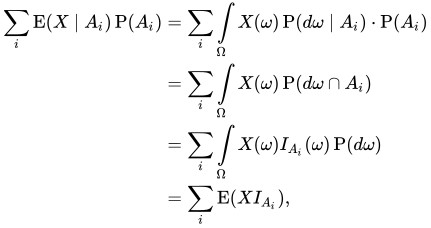
where  is the indicator function of the set
  .
.
If the partition  is finite, then, by linearity, the previous expression becomes
-
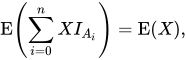
and we are done.
If, however, the partition  is infinite, then we use the dominated convergence theorem to show that
-
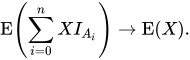
Indeed, for every  ,
,
-
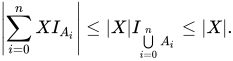
Since every element of the set falls into a specific partition , it is straightforward to verify that the sequence 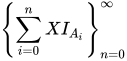 converges pointwise to . By initial assumption,
  . Applying the dominated convergence theorem yields the desired result.
See also [edit]
- The fundamental theorem of poker for one practical application.
- Law of total probability
- Law of total variance
- Law of total covariance
- Law of total cumulance
- Product distribution#expectation (application of the Law for proving that the product expectation is the product of expectations)
References [edit]
- ^ Weiss, Neil A. (2005). A Course in Probability. Boston: Addison–Wesley. pp. 380–383. ISBN0-321-18954-X.
- ^ "Law of Iterated Expectation | Brilliant Math & Science Wiki". brilliant.org . Retrieved 2018-03-28 .
- ^ "Adam's and Eve's Laws". Retrieved 2022-04-19 .
- ^ Rhee, Chang-han (Sep 20, 2011). "Probability and Statistics" (PDF).
- ^ Wolpert, Robert (November 18, 2010). "Conditional Expectation" (PDF).
- Billingsley, Patrick (1995). Probability and measure. New York: John Wiley & Sons. ISBN0-471-00710-2. (Theorem 34.4)
- Christopher Sims, "Notes on Random Variables, Expectations, Probability Densities, and Martingales", especially equations (16) through (18)
0 Response to "Iterated Expectation for Continuous Random Variables"
Post a Comment